
The January Drop-Off
Every January, businesses enter the year feeling energized and optimistic. Marketers pack their calendars with bold initiatives, ambitious goals, and new budgets inspired by ‘New Year Marketing Ideas.’ Initially, the enthusiasm feels genuine—and, for a brief period, it is. By February, the initial momentum has begun to decline.
Budgets begin to tighten. Engagement declines, and campaigns begin to stall. Leadership starts questioning the return on investment (ROI). By March, many companies are already cutting spending, pausing initiatives, or abandoning plans altogether.
This pattern repeats every year—not because businesses lack ambition, but because marketers build most January plans on flawed assumptions and unrealistic expectations.
At Yooniversal Media, we observe this cycle across various industries. The problem isn’t the effort; it’s the planning that overlooks performance.
This guide outlines the most common marketing planning mistakes, explains why traditional New Year marketing resolutions fail, and introduces a flexible, performance-based marketing framework on how to build a strategy designed for sustained growth throughout 2026 and beyond.
The Top 3 Marketing Planning Mistakes That Kill Momentum
Many businesses unknowingly sabotage their own success even before the first quarter ends. Below are the three most damaging mistakes marketing campaigns make that we see every January.
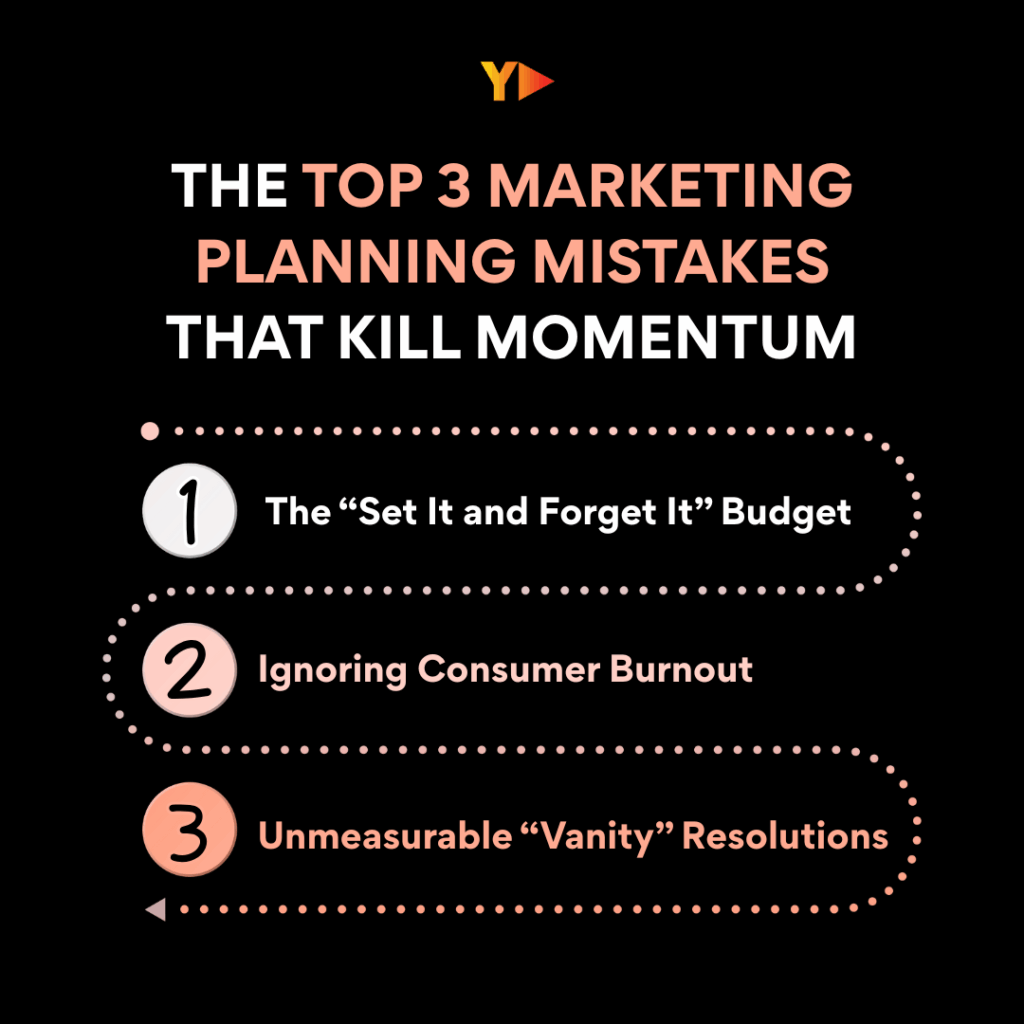
Mistake #1: The “Set It and Forget It” Budget
The failure:
Many companies allocate their marketing budget based on last year’s numbers or a fixed percentage of revenue. Once leaders set the budget, they rarely change it—regardless of specifically measurable performance.
This approach ignores seasonality, channel performance, and real-time data. When a campaign underperforms, teams continue to spend money inefficiently. Conversely, even when an approach proves effective, opportunities to scale it are limited.
The fix:
Replace static budgets with scalable, performance-based plans. Investment should fluctuate based on metrics such as:
- ROAS (Return on Ad Spend)
- CPL (Cost Per Lead)
- CAC (Customer Acquisition Cost)
Marketing dollars should flow toward what works and away from what doesn’t.
This shift alone often results in 30–50% improvement in increased sales and efficiency.
Mistake #2: Ignoring Consumer Burnout
The failure:
By January, consumers are exhausted. After months of holiday spending, they shift into saving, planning, and self-improvement mode. Yet many brands rush straight into aggressive sales campaigns for a product or service.
This disconnect leads to low engagement and poor conversion rates.
The fix: The “Align” Strategy
Instead of selling immediately, align your messaging with consumer psychology. January content should focus on:
- Productivity
- Health and wellness
- Efficiency
- Education and planning
Brands that help customers prepare for success earn trust first and can then convert later.
This approach significantly improves mid-funnel performance and reduces paid ad fatigue.
Mistake #3: Unmeasurable “Vanity” Resolutions
The failure:
Many common New Year marketing resolutions sound appealing but lack substance:
- “Increase brand awareness.”
- “Post more content.”
- “Improve engagement”
Without measurable benchmarks, these goals can’t guide decisions or justify investment.
The fix:
Every marketing resolution must be SMART:
- Specific
- Measurable
- Achievable
- Relevant
- Time-bound
If you can’t track it, you can’t scale it.
Building a Performance-Based Marketing Framework for 2026
How to Set Marketing Goals That Actually Work
Instead of vague resolutions, your January strategy should begin with one question:
What role does marketing play at every stage of the funnel?
Top of Funnel: Awareness with Purpose
January awareness campaigns should attract users who are actively considering change and improvement.
Effective top-of-funnel (TOF) strategies include:
- Educational blog posts
- SEO-driven thought leadership
- Short-form video addressing common pain points
- Paid ads focused on value, rather than offers
The goal should be relevance, not just reach.
Middle of Funnel: Lead Generation That Builds Trust
Once attention is captured, the next goal is education and qualification.
High-performing middle-of-function (MOF) strategies include:
- Downloadable guides
- Webinars and workshops
- Email nurturing sequences
- Comparison content
These assets can transform passive interest into Marketing Qualified Leads (MQLs).
Bottom of Funnel: Conversion Optimization
By the time users reach the bottom of the funnel (BOF) stage, the focus should be on reducing friction.
This includes:
- Personalized landing pages
- Clear offers tied to intent
- Social proof and case studies
- Conversion rate optimization (CRO)
Even small improvements here can yield significant ROI gains.
Define KPIs Before You Launch
Every resolution must be tied to a Key Performance Indicator (KPI).
Example:
Resolution: Increase MQLs by 15% in Q1
Metrics:
- Lead magnet conversion rate
- Webinar registrations
- Cost per lead
KPIs turn strategy into accountability.
The “Test and Scale” Mandate
A sustainable marketing plan anticipates failure—and allocates a budget for it.
Allocate 10–15% of your budget to testing:
- New social media platforms (e.g., TikTok, Pinterest, YouTube Shorts)
- New creatives or messaging angles
- Emerging formats
Successful campaigns receive additional funding, while underperforming campaigns are paused. This approach fosters scalable growth without reckless spending.
The Measurement Mandate: Making Resolutions Stick
Why Most Marketing Plans Collapse by February
Marketing resolutions often fail because performance reviews occur too late in the process.
Monthly reviews can allow small problems to escalate into expensive ones.
Weekly Performance Reviews
Successful teams conduct weekly performance check-ins that focus on:
- Spend vs. return
- Lead quality
- Funnel drop-off points
This agile approach enables quick adjustments and helps prevent budget waste.
Technology and Attribution Matter
If revenue cannot be traced back to a specific marketing effort, decision-making becomes a guessing game.
Your technology stack should include:
- CRM integration
- Conversion tracking
- Analytics dashboards
- Attribution modeling
- Pay per click ppc
Data clarity translates to confidence in your marketing decisions.
Play the Long Game
The most effective New Year marketing resolutions prioritize sustainability over quick wins.
Marketing should build momentum over time, rather than spiking and crashing.
Conclusion: Commit to Performance, Not Just Planning
January marketing doesn’t fail because businesses lack effort; it fails because effort isn’t supported by a measure successful performance framework.
Hope-based marketing leads to burnout while data-driven marketing fosters growth.
In 2026, avoid setting resolutions that are unmeasurable. Instead, create a system that evolves, adapts, and scales.
Yooniversal Media helps businesses transition from static plans to flexible, performance-based marketing strategies designed to last well beyond Q1.
📞 Ready to build a January marketing strategy that won’t collapse by February?
Contact Yooniversal Media today for a free 2026 marketing audit and planning session.
🌐 https://yooniversalmedia.com
FAQ: January Marketing Strategy & Planning
1. Why do the majority of January marketing plans prove unsuccessful?
They often depend on fixed budgets, vague goals, and delayed performance reviews instead of real-time optimization for the target market.
2. What are the most significant marketing planning errors that businesses commit?
Common mistakes include relying on static budgets, ignoring consumer burnout, and setting unmeasurable goals.
3. How do I set realistic New Year’s resolutions for my business?
Tie every goal to a key performance indicator (KPI), define specific timelines, and review performance weekly with the marketing team.
4. Which priorities should guide January marketing beyond immediate sales?
Focus on education, aligning with consumer goals and customer service, and creating trust-building content.
5.What portion of the budget should teams allocate for testing?
Ideally, reserve 10–15% of your budget for testing new channels, creatives, or formats.
6.Which key performance indicators are most critical during the early part of the year?
Key metrics include cost per lead, lead quality, engagement rate, and funnel conversion.
7. Is performance-based marketing only for large businesses?
No. Small businesses and mid-sized businesses benefit the most from it because efficiency is more critical for them.
8. How often should marketing performance be reviewed?
Weekly reviews allow for quick corrections and help prevent wasted spending.
9. What tools are essential for measuring marketing success?
Essential tools include CRM systems, analytics platforms, conversion tracking, and attribution tools.
10. How can Yooniversal Media support my business objectives in 2026?
We can build scalable, data-driven marketing frameworks tailored to your goals, budget, and growth stage.