The digital landscape has shifted beneath our feet. If you are still looking at your dental practice’s marketing through the lens of 2022, you aren’t just behind—you’re becoming invisible. Welcome to 2026, where the “blue link” era of Google has officially been superseded by the “Answer Era.”
In this new reality, the survival of your practice depends on a single, technical question: Is your dental data scrape-able?
The New Reality
In 2026, the patient journey no longer begins with a scroll through a page of advertisements and organic links. Instead, patients are engaging in nuanced, multi-turn conversations with AI agents. Whether they are using Perplexity, Gemini, or SearchGPT, the query has evolved.
They aren’t typing “dentist near me.” They are asking their smart glasses or mobile assistants:
“Who is the best dentist in Sunnyvale for same-day crowns who accepts Delta Dental and has a reputation for helping patients with dental anxiety?”
The Visibility Gap
This is where the crisis emerges for traditional practices. If your data isn’t structured for these Large Language Models (LLMs) to read, digest, and verify, you do not exist in the AI’s “answer engine.”
When an AI synthesizes a response, it doesn’t “guess.” It crawls the web for high-probability, authoritative data points. If your clinical expertise is trapped in an unoptimized PDF or a buried paragraph of creative prose, the AI will bypass you for a competitor whose data is “cleaner.”
The Solution: The AI-Ready Audit
Traditional SEO hasn’t died, but it has undergone a metamorphosis into Generative Engine Optimization (GEO). To remain competitive, your practice needs an AI-Ready Audit. This isn’t just about keywords; it’s about ensuring your clinical authority is formatted in a way that allows AI bots—the entities now driving 70% of local health queries—to recommend you with 100% confidence.
Beyond Keywords
For twenty years, SEO was a game of repetition. If you mentioned “Dental Implants” enough times, you climbed the ladder. In 2026, AI engines look for context and semantic relationships.
An AI doesn’t just want to see the word “dentist”; it wants to see the relationship between your “dentist” (the Entity), the “CEREC Milling Unit” (the Tool), and the “Success Rate for Single-Visit Restorations” (the Outcome). GEO focuses on building this web of meaning so that the AI understands exactly what you do, how you do it, and for whom.
The Authority Factor: E-E-A-T in the LLM Era
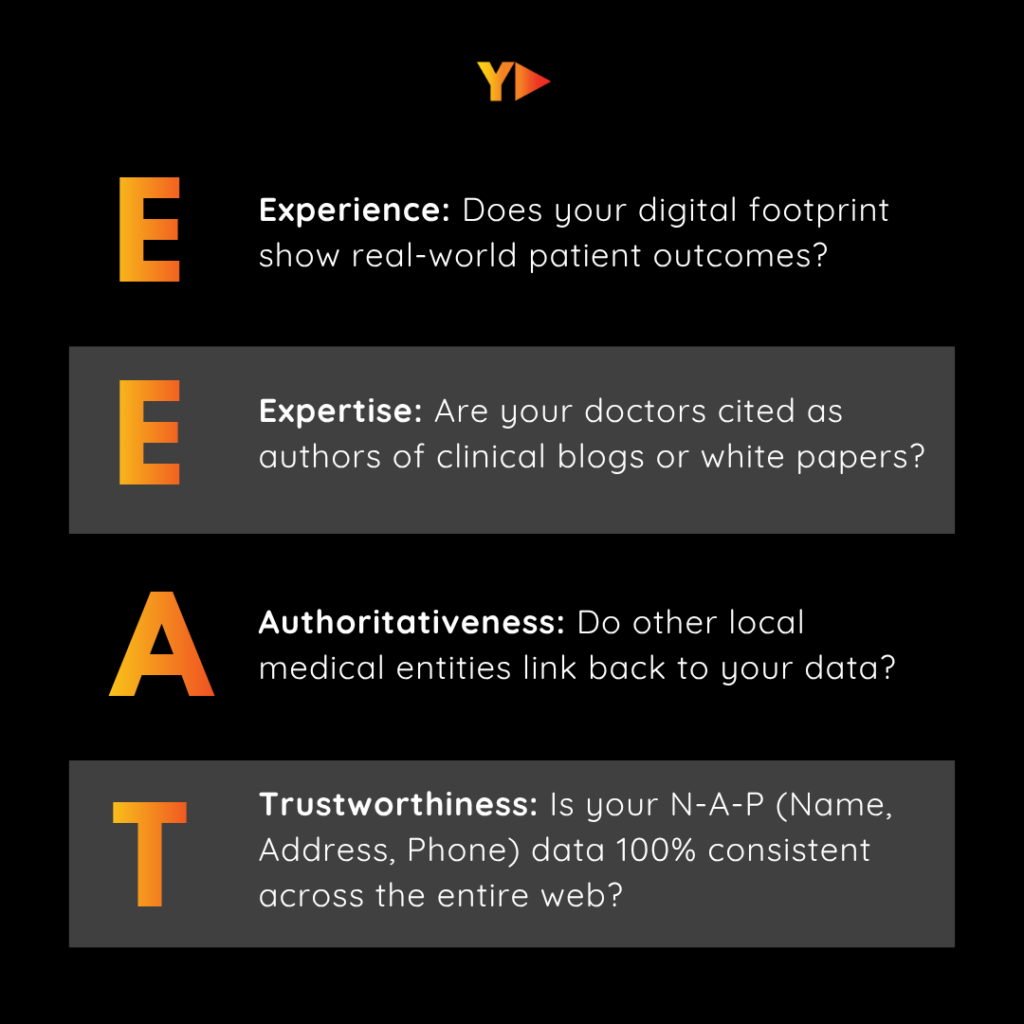
AI prioritizes E-E-A-T (Experience, Expertise, Authoritativeness, and Trustworthiness) more than any algorithm in history.
- Experience: Does your digital footprint show real-world patient outcomes?
- Expertise: Are your doctors cited as authors of clinical blogs or white papers?
- Authoritativeness: Do other local medical entities link back to your data?
- Trustworthiness: Is your N-A-P (Name, Address, Phone) data 100% consistent across the entire web?
At Yooniversal Media, we optimize your digital footprint so AI models recognize your practitioners as the definitive experts in your specific region.
Dental AI SEO Strategy
We have moved away from “filler” blogging. In 2026, we produce high-utility, structured content. We anticipate the complex questions patients ask their AI assistants. Instead of a post titled “Benefits of Braces,” we create data-rich resources like “A Comparative Analysis of Recovery Times: Clear Aligners vs. Traditional Brackets in Adult Patients.” This is the “meat” that AI engines crave.
The “Backbone”: Schema for Dentists
To win at Dental AI SEO, you have to speak the language of the machine. That language is Schema.
What is Schema?
Think of Schema markup as a “translator” for AI. It is a specific vocabulary of code (JSON-LD) that sits behind your website. While a human sees a beautiful photo of your office, the AI sees a code block that tells it exactly:
- Your specific Latitude and Longitude.
- The exact brands of technology you use (e.g., iTero, Biolase).
- Your real-time appointment availability.
- The specific insurance codes you are in-network with.
Local Entity Recognition
By implementing Advanced Schema for Dentists, we ensure that AI models view your practice as a “Verified Entity.” In the LLM era, there are “Probabilities,” and there are “Entities.” If the AI is only 60% sure of your hours, it won’t risk recommending you. If our Schema confirms your data with 99% certainty, you become the “top recommendation” in the AI’s generated response.
Rich Results and AI Carousels
Properly structured data allows your practice to appear in AI Carousels—those swipeable cards at the top of a Gemini or SearchGPT response. This allows you to bypass the traditional search results page entirely. You aren’t fighting for “Rank #1”; you are fighting to be the Answer.
The Yooniversal “Sustainable Marketing” Advantage
At Yooniversal Media, we don’t believe in “chasing the algorithm.” That is an exhausting, expensive, and ultimately losing game. Instead, we lean into a Sustainable Marketing Strategy.
1. Future-Proofing
Our strategy is built on the philosophy that you shouldn’t have to rebuild your SEO every time Google or OpenAI releases an update. By focusing on data architecture rather than “hacks,” your practice stays visible regardless of which AI becomes the next market leader. Whether it’s a voice assistant in a car or a chatbot on a phone, they all pull from the same well of structured data.
2. Data Integrity and the “Knowledge Graph.”
We ensure your practice’s information is consistent across the entire “Knowledge Graph.” This includes your website, your Google Business Profile, Apple Maps, local directories, and the training sets used by LLMs. If your office closes at 4:00 PM on Fridays on your website but says 5:00 PM on a directory, an AI perceives this as “low-trust data” and will demote you. We maintain your integrity everywhere.
3. Conversion-Centric Optimization
Being “scrape-able” is only half the battle. If the AI tells a patient about you, we want that “answer” to be compelling. We optimize the snippets of information the AI pulls to ensure they include a strong value proposition and a clear path to your booking calendar. We don’t just want the AI to mention you; we want it to sell you.
Frequently Asked Questions (FAQ)
Traditional SEO focuses on ranking higher in search engine results pages (the list of links). Generative Engine Optimization (GEO) focuses on being the primary source and the “cited authority” used by AI models when they generate a conversational answer for a user.
If your organic traffic has plateaued or dropped in the last six months, it’s likely because AI-powered search features are siphoning off your clicks. Patients are getting their answers directly on the search page without ever clicking a link. An audit identifies where your data is “invisible” to these new engines and how to recapture that attention.
Most voice searches (Siri, Alexa, Google Assistant) rely on structured data to provide answers. Because voice results usually only provide one answer, being the most “structured” and “authoritative” source is the only way to be the “voice” that answers a local patient’s query.
Absolutely. Sustainable marketing is about building assets that last. Well-structured data and a verified AI presence are the most durable marketing assets a dental practice can own in 2026. Unlike paid ads, which stop working the moment you stop paying, structured data continues to provide value for years.
Don’t Get Left Behind in the LLM Era
The way patients find you has changed forever. The “digital front door” of your practice is no longer just your homepage; it is the data stream that feeds the world’s most powerful AI engines.
To win in 2026, your practice must be more than just a place where clinical excellence happens; it must be a structured data powerhouse that AI engines trust, cite, and recommend.
Is your practice ready for the AI shift? Don’t wait for your new patient numbers to dwindle before you audit your digital health. Contact us today for a comprehensive 2026 AI-Ready Audit. Let’s make sure your data is working as hard as your clinical team.